
Author · Frankenstein
How a Rainy Summer Contest Gave Us Frankenstein
At eighteen, Mary Shelley joined a ghost-story contest by Lake Geneva and came away with one of the most famous monsters in fiction.
In the summer of 1816, a small group of young writers found themselves stuck indoors at a villa beside Lake Geneva in Switzerland. The weather that year was so cold and wet that it became known as the "Year Without a Summer." With nothing to do but talk and read by the fire, they started a game, and one of them walked away with a novel people are still reading two centuries later.
A dare by the fireside
The villa had been rented by the poet Lord Byron. Staying with him or nearby were the poet Percy Shelley, Mary Godwin (who would soon marry Percy and become Mary Shelley), and Byron's young doctor, John Polidori. After an evening of reading a collection of ghost stories aloud, Byron made a suggestion: each of them should write a ghost story of their own.
Mary later recalled that for days she could think of nothing, and felt embarrassed every morning when asked whether she had an idea yet. Then, after listening to the others talk late into the night about experiments and the nature of life, she lay awake and saw a vivid picture in her mind: a student of science kneeling beside the thing he had put together, terrified by what he had made. That image became the seed of Frankenstein.
A teenage author
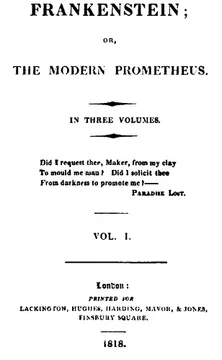
Mary was eighteen that summer. What began as a short tale grew, with Percy's encouragement, into a full novel. It was published in January 1818 without the author's name on it, when Mary was twenty. Many early readers assumed a man had written it, and some guessed it was Percy.
The same contest produced another lasting story. Polidori wrote "The Vampyre," which helped shape the vampire tales that followed. One wet summer, one house, and two branches of horror fiction were born.
The daughter of two writers
Mary grew up surrounded by ideas. Her mother, Mary Wollstonecraft, wrote A Vindication of the Rights of Woman, arguing that girls deserved the same education as boys. Sadly, she died just days after her daughter was born. Mary's father, William Godwin, was a philosopher and novelist whose home was full of books and visiting thinkers.
Mary had little formal schooling, but she read widely in her father's library and returned again and again to her mother's writing. Perhaps it is not surprising that a girl raised among arguments about society and responsibility would write a novel asking a hard question: what does a creator owe to the life it brings into the world?
A question to think about
Mary Shelley began this novel with the image of a scientist trembling before the being he had made. Her question, what a creator owes to the life he creates, feels even closer two hundred years later. Scientists are building new life technologies and machines that make decisions on their own, and no one can foresee every result.
When a new technology causes harm nobody expected, who carries the most responsibility: the people who made it, the people who use it, or the society that allowed it? Is being able to build something ever enough reason to build it?