
Story · Treasure Island
Treasure Island Began With a Map on a Rainy Day
How a map drawn alongside a stepson became a pirate adventure, first printed in a children's magazine under a pen name.
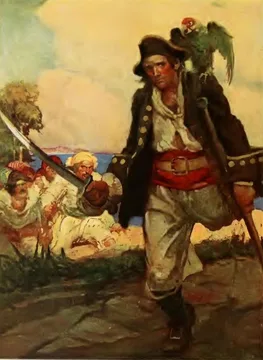
Pirates, buried gold, a one-legged sailor with a parrot. A great deal of what we picture when we hear the word "pirate" was shaped by a single novel, Robert Louis Stevenson's Treasure Island. Remarkably, the book started not with a sentence but with a map.
A map to pass a wet afternoon
In the summer of 1881, Stevenson and his family were on holiday in Braemar, a village in the Scottish Highlands. The weather was miserable, and everyone spent a lot of time indoors. His stepson, Lloyd Osbourne, was about twelve and passing the hours with paints and paper. Stevenson sat down beside him and drew the map of an island.
As he shaped the coastline and gave names to its hills and bays, Stevenson later recalled, characters seemed to rise up out of the imaginary woods, and a story about the island's treasure took shape. He started writing right away and read the chapters aloud to the family as he went. Since the hero was a boy, Lloyd made the perfect first listener.
A story in installments
Treasure Island did not appear as a book at first. It ran in a children's magazine called Young Folks, a little at a time. This is called serialization, and in the nineteenth century it was a common way to publish novels, a bit like waiting for the next episode of a favorite show.
The name printed in the magazine was not Stevenson's but "Captain George North," a pen name. The story came out as a single book in 1883, and that is when it found a much wider audience.
Meet Long John Silver
The tale opens at the Admiral Benbow, a seaside inn run by the family of young Jim Hawkins. A rough old sailor comes to stay, and through him Jim ends up with a treasure map. Soon Jim is aboard a ship bound for the island, sailing with a group of adults. What happens there is best discovered by reading.
On board is the ship's cook, Long John Silver. He gets about on one leg with a crutch and keeps a parrot named Captain Flint. He is funny, clever and kind to Jim, and yet readers sense from early on that he is hard to read. That mix is the secret of his staying power. Silver refuses to fit neatly into the box marked "good" or the box marked "bad," and readers keep arguing about him long after the last page.
Stevenson said that Silver was partly inspired by his friend, the poet William Ernest Henley, who had lost part of a leg to illness.
A question to think about
Much of our picture of pirates, from the sailor on a crutch to the parrot on his shoulder, was fixed by this novel. Stevenson based Silver on his friend Henley, who had lost part of a leg to illness, yet crutches and wooden legs later became shorthand for a suspicious villain. How characters look in stories can shape how we see real people.
If a character's appearance feeds prejudice against real people, does the responsibility lie with the writer, or with the readers and society who took it that way? And how should we judge someone like Silver, who cannot be sorted neatly into good or bad?