
Society · Oliver Twist
The Workhouse World That Made Oliver Twist
England's New Poor Law, the workhouse and London's street children, and what Dickens wanted his readers to see.
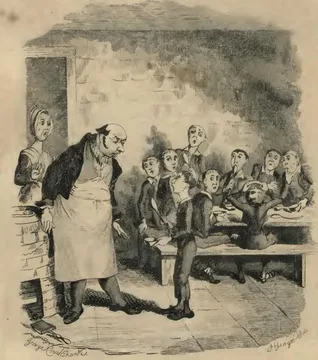
A hungry boy finishes his bowl of thin gruel, walks up to the master and asks for more. The adults are horrified, and the boy is marked as a troublemaker. This scene from Charles Dickens's Oliver Twist is not just a sad joke. It holds up a mirror to how poor children in England were really treated in the 1830s.
A law that punished being poor
Oliver Twist came out in monthly parts beginning in 1837. A few years earlier, in 1834, Parliament had passed the New Poor Law, which changed how the poor received help. In most cases, people who needed relief had to enter a workhouse and live there.
The law's designers worried that if workhouse life were too comfortable, people would stop looking for work. So food was kept scarce, families were split up, with men, women and children housed apart, and inmates were given hard, dull labor. Behind the system lay the belief that poverty came from laziness rather than misfortune. Dickens opened his novel with a biting, mock-polite description of the workhouse, and his readers felt the sting.
Children sent out to work
Around the age of nine, Oliver is moved into the workhouse, and before long he is apprenticed to an undertaker. Apprenticeship was supposed to teach a young person a trade, but many apprentices were simply used as cheap labor. Children working in factories, in the streets or climbing chimneys as sweeps were a common sight.
Dickens knew something of this from his own childhood. When his father was sent to a debtors' prison, twelve-year-old Charles was put to work in a factory pasting labels onto pots of boot blacking. He carried the shame and loneliness of those months with him for the rest of his life.
Another kind of home
Oliver runs away to London and falls in with Fagin, an old man who gives a gang of boys food and a place to sleep in return for picking pockets. Dickens does not paint these boys as wicked from birth. He wants readers to notice where children end up when no one is willing to care for them.
A question to think about
The men who wrote the New Poor Law believed that help given too easily would make people idle, so workhouse meals were kept deliberately small. The result was a world in which a child like Oliver could be punished simply for asking for more. Today, people still argue about welfare: how to help those who truly need it while preventing abuse of the system.
When a society builds a system to help the poor, how can it protect the dignity of those who receive help and still share resources fairly? And what happens to children when the adults around them treat poverty as a personal failing?